Cargo Securement: Why Half Your Tiedowns Count for Half
The securement rule is not just half the weight. It also says how to add up to it, and a tiedown that ends on the cargo counts half of what its tag says. Four chains can be 26,400 pounds or 13,200 depending only on where the ends go.
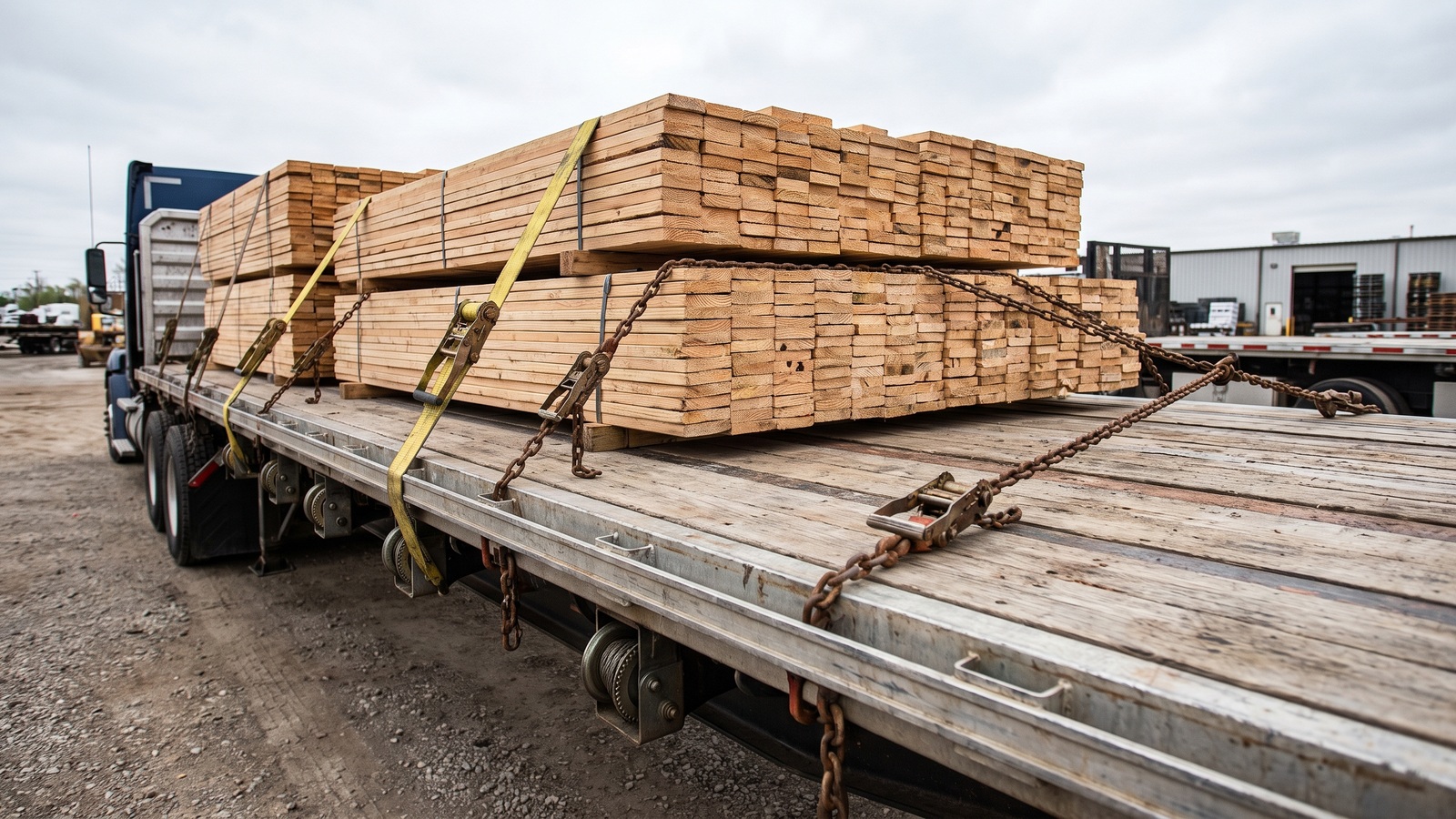
Two chains that look identical over the same load can be worth different numbers on an inspection report, and the difference is not the chain. It is where each end goes. Most drivers know the securement rule as "half the weight." The half is the easy part. How you add up to it is where loads fail.
The half everybody knows
The federal requirement is in 49 CFR 393.106(d): the aggregate working load limit of the tiedowns holding an article has to be at least one-half times the weight of that article. Ten thousand pounds of steel needs five thousand pounds of aggregate. That much is common knowledge and it is correct.
What the same paragraph then does is define the word aggregate, and that definition is not a plain sum of the tags.
The part that costs people loads
The rule sorts tiedowns into three cases:
- Vehicle anchor to an anchor on the cargo itself — counts half its working load limit.
- Vehicle anchor, over or around the load, back to an anchor on the same side — counts half.
- Vehicle anchor, over the load, down to an anchor on the other side — counts its full working load limit.
Run the arithmetic on that. Four 3/8-inch grade 70 chains rated 6,600 pounds each look like 26,400 pounds of securement. If all four cross the load and anchor on the opposite rail, that is exactly what you have. If all four are hooked into anchor points on the cargo, the same four chains count 13,200 — half of what the tags add up to. Same chains, same load, same driver, half the number.
Nothing about the load looks different from the ground. The paperwork does.
Your chain is only as strong as its cheapest part
Section 393.108 sets the working load limit of a tiedown at the lowest working load limit of any component in the assembly — the connector, the attachment, the tensioner — or of the anchor point it is attached to, whichever is less.
That is the sentence that turns good chain into a mediocre number. A grade 100 chain through a binder rated below it is worth the binder. A perfect assembly hooked into a rusted stake pocket is worth the pocket. And 393.104 makes the condition of that pocket a compliance item in its own right: decks, anchor points, stakes, posts and mounting pockets have to be free of cracks or cuts that reduce what they can hold.
Unmarked gear gets rated at the bottom
Markings govern. When the manufacturer marks a working load limit, that is the number. When nothing is marked, 393.108 assigns a default, and the defaults are conservative on purpose:
- Unmarked welded steel chain is treated as grade 30 proof coil. In 3/8 inch that is 2,650 pounds instead of the 6,600 you would get from marked grade 70 — the same chain, rated at 40 percent, because nobody can read it.
- Unmarked synthetic cordage is rated as polypropylene fiber rope, the weakest of the family.
- Unmarked wire rope is rated at one-fourth of its nominal strength, and if the construction cannot be identified, as 6 × 37 fiber core.
- Unrated friction mats count as resisting 50 percent of the weight sitting on them.
A worn tag is not a paperwork problem. It is a rating cut.
The two sets of g-numbers behind all of it
Section 393.102 is where those halves come from. The system has to hold the load without exceeding the manufacturer's breaking strength at 0.8 g forward, 0.5 g rearward and 0.5 g lateral. It also has to hold without exceeding the working load limit, and there the figures drop to 0.435 g forward, 0.5 g rearward, 0.25 g lateral. Each condition is applied separately.
Notice which direction is worst in the working-load column: forward, at 0.435 g. That is a hard stop, and it is why the rule cares so much about tiedowns that actually resist forward movement rather than just sitting on top of the load looking tight.
Five things worth doing before the next load
- Count by where the ends go, not by how many you threw. Sort your tiedowns into the three cases above and add them properly. Do it once on your usual load and you will remember it.
- Read the tag on every binder and ratchet, not just the chain or strap. The assembly is worth its weakest link and the tensioner is part of the assembly.
- Walk the anchor points. Stake pockets, rub rails, winch track and D-rings. A cracked pocket lowers the rating of everything hooked to it.
- Replace anything you cannot read. Unmarked gear gets assessed at the bottom of its class, and you will not win that argument roadside.
- Chock or cradle whatever can roll, and make sure the chock cannot work itself loose in transit — 393.106(c) asks for exactly that.
The honest bottom line
Securement is one of the few areas where the rule hands you actual arithmetic instead of judgment. That cuts both ways: you cannot argue a shortfall, and you also cannot be talked into adding straps you do not need if your numbers are right. Learn the three cases and you stop guessing.
If you are pricing chain, binders or straps, the parts and accessories catalog at The Truck Savers store is a practical place to start, and there is more operator-side maintenance and compliance coverage at thetrucksavers.com.
Original source
Electronic Code of Federal Regulations — 49 CFR 393.106, with 393.102, 393.104 and 393.108 of the same subpart, text in force August 1, 2026.