Brake Week 2026 Targets Drums and Rotors
Brake Safety Week started today and runs through August 29. This year inspectors are focused on drums and rotors. April's one-day version parked 574 trucks out of 4,021 inspections.
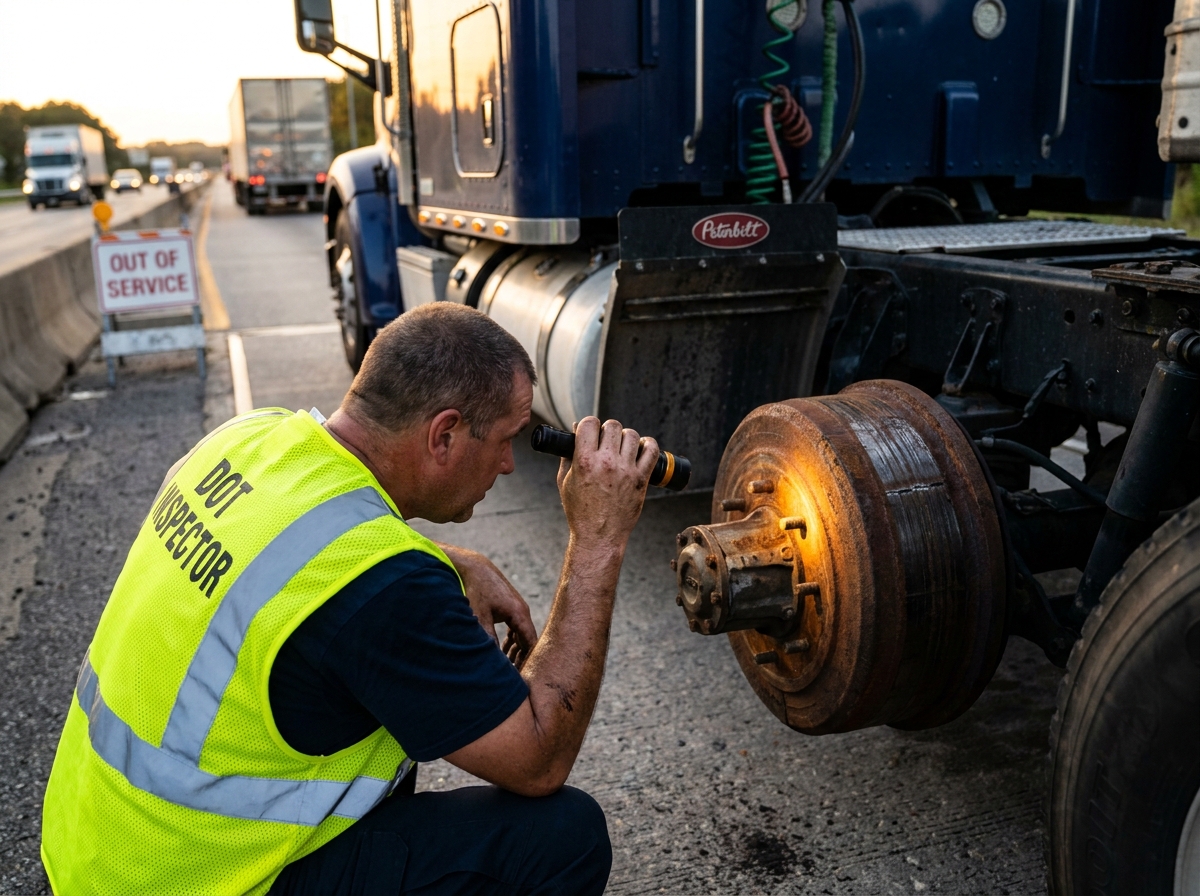
It started today. In April's unannounced rehearsal, one truck in seven was pulled off the road.
The number one finding was a rusted rotor: 24 of the 43 drum and rotor violations.
Inspect your drums and rotors for rust and cracks before the next route.
Brake Safety Week runs August 23 through 29, and for those seven days certified inspectors in the United States, Canada and Mexico are pulling commercial vehicles into inspection lanes with one system in mind. The part worth knowing before you roll: this year the emphasis is drums and rotors. Not brakes in general — the two round pieces that most pre-trips never actually look at.
April already showed you the movie
CVSA ran its unannounced one-day version on April 14. In a single day, inspectors completed 4,021 inspections and pulled 574 vehicles off the road for brake violations. That is 14.3% — roughly one in seven.
The other side of that number matters too: 3,447 units, 85.7%, had no brake violation at all. This is not a lottery. It is a maintenance test with a published syllabus.
What the drum and rotor push actually found
Inspectors wrote 43 drum and rotor violations in that one day, and 21 of them were serious enough to park the truck. The breakdown is the useful part:
- Rusted rotor — 24. The single most common finding, by a wide margin.
- Broken drum — 9. All of them on S-cam brakes.
- Broken rotor — 8. All on air disc brakes.
- Metal-to-metal contact — 2.
Read that split again. 33 of the 43 were on air disc brakes, 9 on S-cam, 1 hydraulic. Newer equipment is not exempt from this one — if anything, the rotor is where the attention is going.
The 20% rule parked far more trucks than the drums did
On the same day, 313 vehicles met the 20% defective brakes criterion: when 20% or more of the brakes on the vehicle or combination have a condition that impairs braking enough to count the brake as defective. On a five-axle set, that math gets ugly faster than most owners expect.
Add the rest of what came out that day: 121 violations on brake hoses or tubing, 47 steering axle violations, 40 units that failed an air loss rate test, and 193 other brake violations — inoperative tractor protection, parking brake, low-air warning.
Where the regulation sends you for the number
Here is the detail that catches shops: 49 CFR 393.47(g) does not give you a thickness. It says the thickness of drums or rotors shall not be less than the limits established by the drum or rotor manufacturer. The number lives on the casting, in the service manual — not in the rule.
Linings are the opposite. The same section is specific:
- Steering axle, air drum brakes: not less than 4.8 mm (3/16 inch) at the shoe center with a continuous strip of lining, or 6.4 mm (1/4 inch) with two pads, or worn to the wear indicator if marked.
- Steering axle, air disc: not less than 3.2 mm (1/8 inch).
- Non-steering axles, air brakes: not less than 6.4 mm (1/4 inch) for drum, 3.2 mm (1/8 inch) for disc.
- Hydraulic or electric brakes: not less than 1.6 mm (1/16 inch).
Two more from the same section are free to check and easy to fail: the service and spring brake chambers on each end of an axle must be the same size, and the slack adjusters on each end of an axle must have the same effective length. Nobody notices a mismatched chamber until somebody with a checklist does.
The machine, and the 43.5%
Ten U.S. jurisdictions used a performance-based brake tester on 349 of those inspections. The required minimum braking efficiency is 43.5%, and 26 vehicles (7.45%) did not make it. A truck can pass a visual walk-around and still fail on a machine that measures what the brakes actually do.
And the format: 3,643 of the inspections (90.6%) were Level I — the full 37-step procedure that goes through the driver's paperwork and the vehicle's mechanical condition. During Brake Safety Week, a brake stop is rarely only a brake stop.
What to do with the next seven days
- Pull a wheel, or at least look through it. Rusted and scored rotors were the number one finding, and they are visible.
- Get the manufacturer's discard thickness for your drums and rotors and keep it where the mechanic can read it.
- Measure lining at the shoe center, not at the thickest point.
- Compare left to right — chamber size and slack adjuster length, both ends of every axle.
- Do the air loss test before somebody else does it for you.
A brake job on your schedule costs less than a brake job on the shoulder of a highway. At The Truck Savers™ the inspection is free and no appointment is needed, and Truck Savers News keeps covering the regulatory side of the trade. Get the weekly TSN newsletter and see the rules before they see you.
Original source
Dates and this year's focus area come straight from the organizer: CVSA, Brake Safety Week Scheduled for Aug. 23-29. The April figures are from CVSA's Brake Safety Day results, and the thickness requirements from 49 CFR 393.47.