APU Weight Exemption: 550 Pounds, Proof Required
The APU weight exemption is capped at 550 pounds, not granted at 550: it covers what the unit weighs. And proof that it is fully functional is part of the rule.
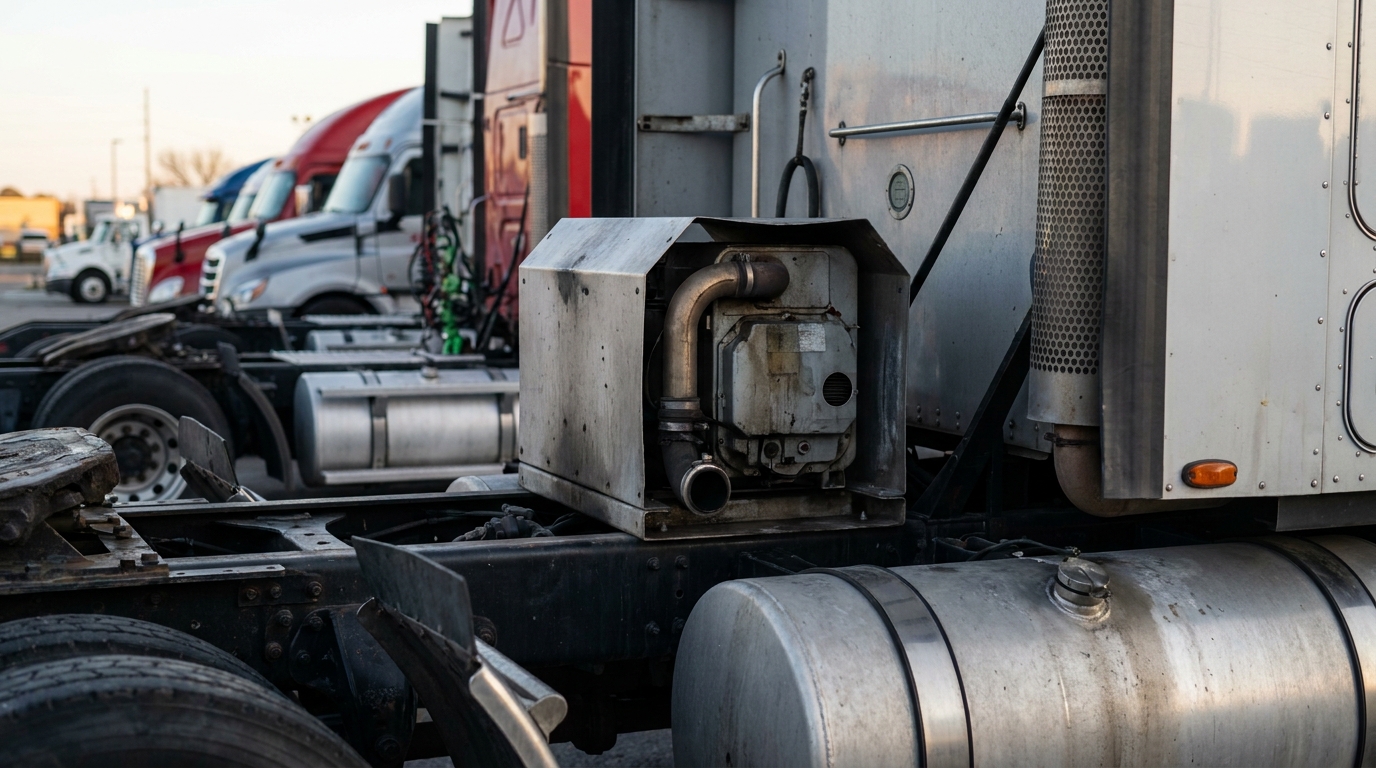
If your truck carries an APU, federal law lets you run heavier — but not by a flat 550 pounds, and not without being able to prove it at the scale.
The rule is 23 U.S.C. 127(a)(12), and it is three short subparagraphs. Most of what gets repeated about it collapses the three into one sentence, and the part that gets lost is the part an inspector asks about.
Check what your idle reduction unit actually weighs before you assume the full exemption.
What the law grants
Subparagraph (A) says that in order to promote reduction of fuel use and emissions because of engine idling, the maximum gross vehicle weight limit and the axle weight limit for any heavy-duty vehicle equipped with an idle reduction technology shall be increased by a quantity necessary to compensate for the additional weight of the idle reduction system.
Read that carefully. It is not a bonus. It is compensation for what the unit weighs, and it covers both the gross limit and the axle limit — which matters, because an APU sits on one end of the tractor and lands on one axle group.
Where the 550 comes from
Subparagraph (B) is one line: the weight increase shall be not greater than 550 pounds.
That is a ceiling, not an allowance. If the unit and its mounting weigh 400 pounds, the exemption is 400 pounds. The number 550 only shows up when your system actually weighs that much or more.
The proof requirement almost nobody quotes
Subparagraph (C) is where a good day at the scale turns bad. On request by a regulatory agency or law enforcement agency, the vehicle operator shall provide proof — through demonstration or certification — that:
- the idle reduction technology is fully functional at all times; and
- the weight increase is not used for any purpose other than the idle reduction technology.
"Demonstration" means exactly what it sounds like: they can ask you to start it. A unit that is dead, disconnected or waiting on a part is not fully functional, and on that day the exemption is not there to lean on.
Why the axle half matters more than the gross half
An APU is not distributed weight. It hangs off the frame rail on one side, behind the fuel tank, and it lands almost entirely on the drive axles. That is why the statute names the axle weight limit and not just the gross limit: the gross number is rarely where an APU puts you over.
If you have ever come off a scale legal on gross and heavy on the drives, you already know the shape of this problem. The exemption is written to cover exactly that case, and it is the reason the certification is worth having in the truck rather than at the office.
What this means when you are loaded to the line
We wrote recently about the three numbers a scale checks — 80,000 gross, 34,000 on a tandem and 20,000 on any one axle. The APU exemption applies to those limits, but only for the weight of the unit, and only while the unit works.
So if you plan your loads assuming a flat 550 pounds of headroom and your unit weighs 380, you built 170 pounds of imaginary capacity into every trip.
What to keep in the truck
- The unit's weight in writing. Manufacturer documentation or an installer's certification stating what the system weighs, installed.
- Something that shows it runs. If it will not start on request, the paperwork does not save the exemption.
- A maintenance record. "Fully functional at all times" is a standing condition, not a one-time inspection.
- Your own scale ticket math. Know which axle group the unit loads, since the exemption covers the axle limit too.
The preventive read
This is one of the few places where a piece of equipment pays you twice: it saves the fuel you were burning at idle, and it buys back the weight it costs you. Both halves depend on the same thing — that it works the day somebody asks.
Looking at idle reduction for your truck? Go Green APU has the equipment side. And The Truck Savers™ handles inspections and suspension work in Houston and Dallas.
This is general information, not legal advice. Section 127 governs the Interstate System; check how your state applies weight limits on other roads.
Original source: 23 U.S.C. 127, Vehicle weight limitations — Interstate System