All Ten Tires Wearing Outside Is Not Alignment
Wearing on one axle points at geometry. On all ten tires it points at air pressure. The pattern says which, before you pay.
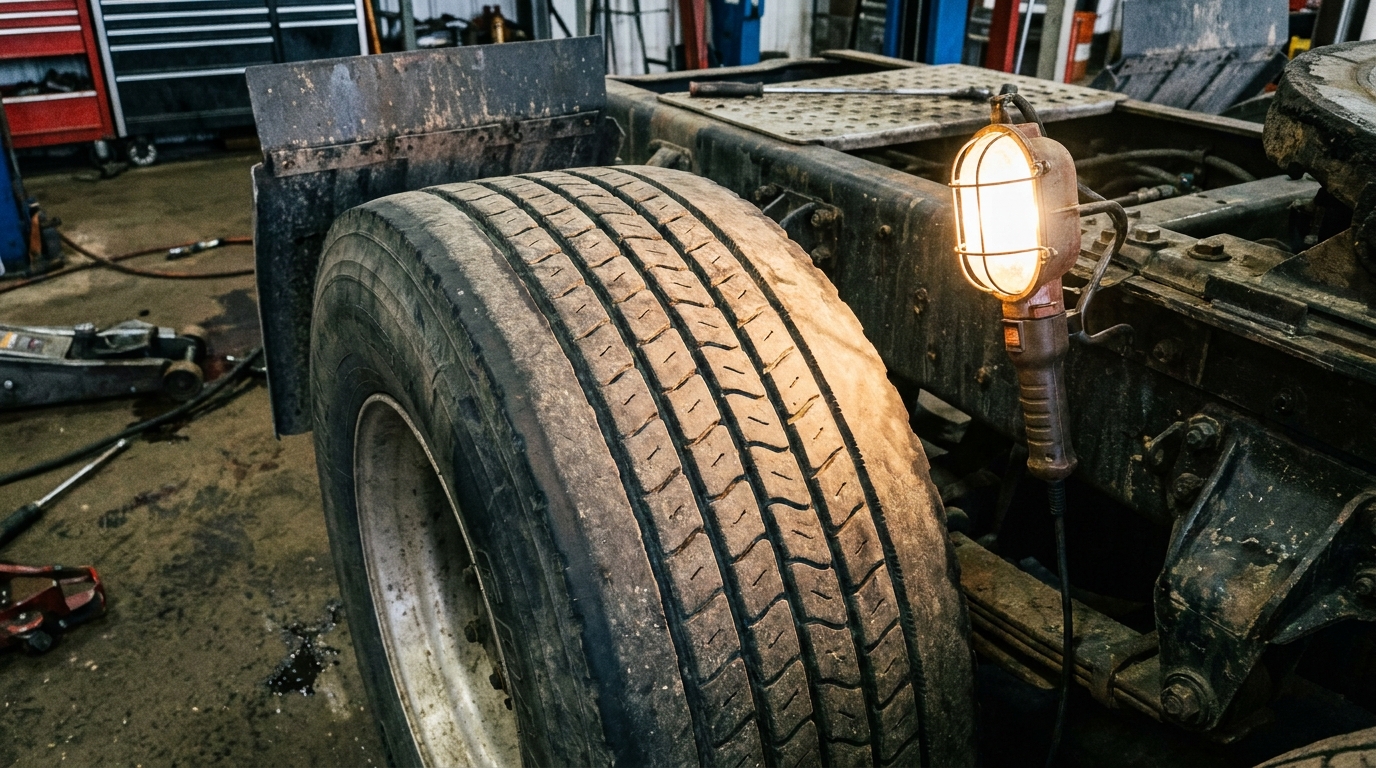
A driver asked us this week why all ten of his tires were wearing on the outside. Not one axle. All ten.
That number is the answer. When the wear shows up on one axle, you look at geometry. When it shows up on every position on the truck, geometry is not doing that. Air is.
The tire does not carry the load. The air does
This is the part that gets skipped. The rubber holds the air and puts it on the road, but the thing actually holding up your truck is the air pressure inside the tire, working against the load on that axle.
Get that pressure right and the tread sits flat on the pavement, so the whole width wears at the same rate.
Run it low and the tread stops sitting flat. The middle lifts slightly and the two shoulders take the weight. They are now doing the work of the whole tread, so they wear out first, on both edges, on every tire that is underinflated.
Run it high and the opposite happens. The center crowns up, carries more than its share, and wears down the middle while the shoulders still look new.
So the wear pattern is telling you something specific, and it is not the same thing an alignment problem tells you.
Reading the pattern before you spend anything
Both shoulders, same tire, across many positions. Underinflation. Check pressure before you check anything else.
Center only, across many positions. Overinflation.
One shoulder, one axle. Now you are looking at geometry — camber, toe, a bent component, or a trailer that is not tracking straight.
Scalloped or cupped, one position. That points at what is holding the wheel: shocks, bushings, a bearing.
The reason this matters is money. Inflation you fix with a gauge and five minutes. Geometry you fix on a rack. Confusing the two means paying for the second one to solve the first one, and then watching the tires wear the same way again.
The number on the sidewall is not your number
Here is where most of it goes wrong. The pressure molded into the sidewall is the tire's maximum — the most it is rated to hold. It is not a recommendation for your load.
The pressure you actually want comes from the manufacturer's load and inflation table, read against the real weight on that axle. Same tire, different load, different correct pressure. A truck running empty and the same truck loaded do not want the same number.
Which means you need two things you may not have: the table for the tire you are running, and a scale ticket that tells you what that axle actually weighs. Both are free. Neither is a guess.
How to check it so the reading is real
Check cold. Rolling heats the air and raises the pressure, so a tire checked hot will read high and tell you everything is fine when it is not. Cold means before the truck moves, or at least a few hours after it stopped.
Check every position, not one per axle. On duals especially, the two tires share the load, and if one is low the other is carrying more than it should — which is how you get one blowout and one that looks fine sitting next to it.
Use a gauge you trust and check it against another one now and then. A gauge that reads ten pounds high will have you running every tire on the truck ten pounds low, forever, and the wear pattern will keep telling you the truth while the gauge keeps lying.
And write down what you find, position by position, the first time you do it. The second check is where the information actually is: a tire that keeps dropping while the others hold is not an inflation habit, it is a leak, and that one needs a shop and not a gauge.
If the pressure is right and it still wears outside
Then you have earned the alignment. You have ruled out the cheap explanation with a gauge, and now the expensive tool is pointed at the right problem instead of guessing.
That order matters. It is the difference between paying once and paying twice.
We do alignment and tire work in Houston, Dallas and Monterrey: thetrucksavers.com.
Reference: 49 CFR 393.75, tires (FMCSA)