A Washout Receipt Does Not Guarantee Sanitization
A washout receipt has limits. Check the service ordered and the next load requirements before leaving the wash bay.
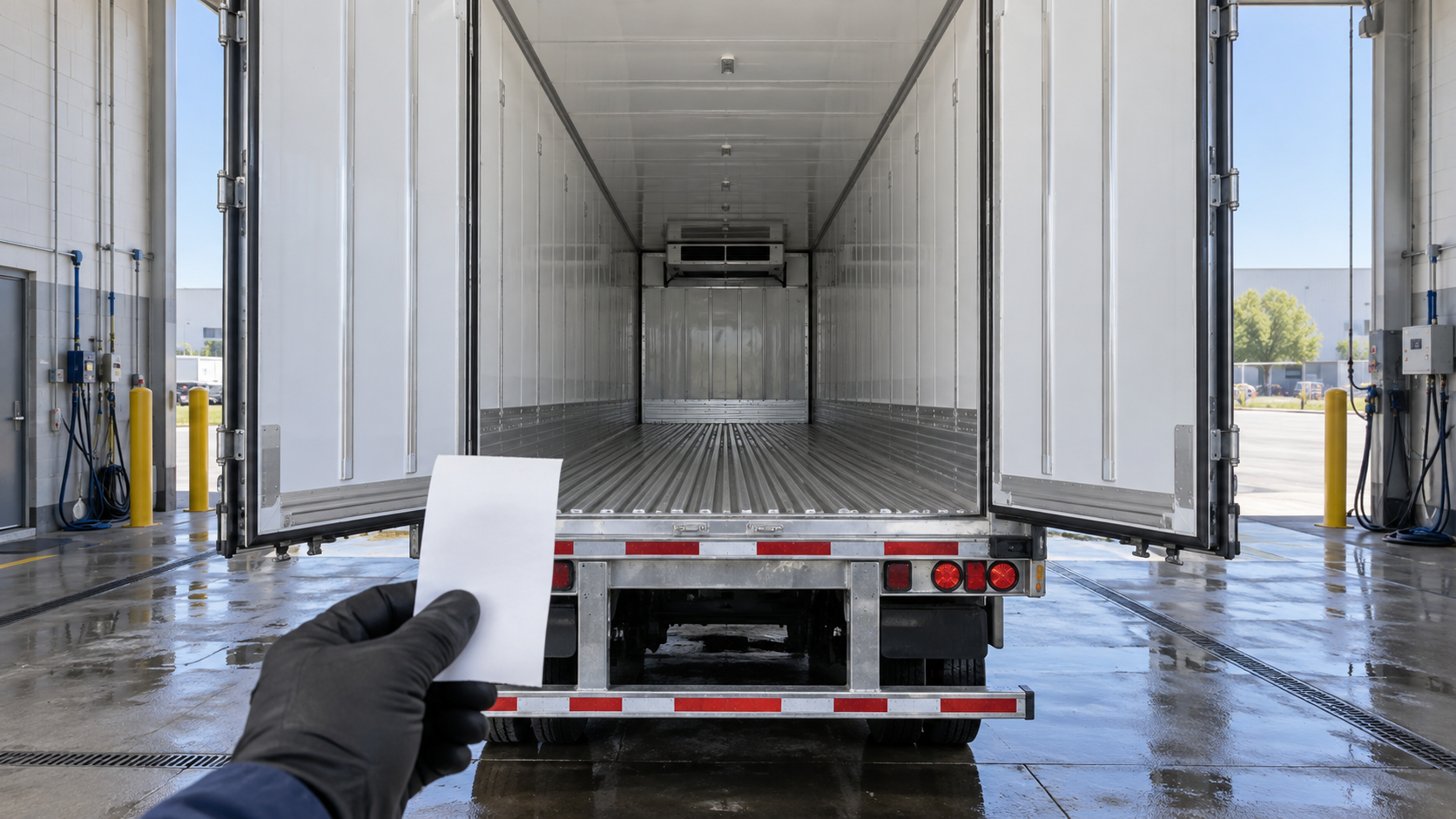
A trailer washout receipt records a service. It does not, by itself, establish that the trailer meets every requirement for its next load. That distinction matters when a driver is choosing a stop between unloading and the next pickup. Ask what must be cleaned, what evidence the customer wants and who can approve an exception before committing the remaining time on the route.
Read the service's limits
Blue Beacon explicitly says its washout service does not guarantee sanitization or complete removal of material left by previous loads. Its published procedure also treats ceiling cleaning as an additional service; without that item on the ticket, drivers should not assume it happened. These are the provider's stated limits, not a conclusion that a particular trailer is unsuitable. Match the ordered service to the actual assignment.
The distinction is practical: a document saying that a washout was purchased answers a different question from a customer's written cleaning requirement. Neither a clean exterior nor a photograph of an empty floor supplies the missing agreement. A driver should not have to guess which standard the next loading facility intends to apply while already standing at its gate.
Get the requirement before choosing a stop
TSN's suggested planning checklist starts with dispatch: identify the next load, the equipment assigned to it and the customer's written instructions. Ask whether the requirement concerns the floor, walls, ceiling or a separate process. If the instruction uses a term such as sanitized, ask the responsible party to define the evidence it accepts. Do not substitute an ordinary washout for a specified treatment based on the name alone.
Record the answer where the driver and dispatcher can both retrieve it. A useful internal note identifies the trailer, the next pickup, the requested service and the contact who clarified it. This is a suggested workflow, not a claim that every customer uses the same form or that a particular receipt guarantees acceptance. Keep the customer's actual requirement attached to the trip.
Confirm the bay and the total job
Blue Beacon lists standard trailer washouts separately from extras such as ceilings, debris and pallets. Its posted prices exclude extras and sales tax, and some locations cost more. The chain also distinguishes regular wash bays from washout-only bays available at selected locations. A location on a map therefore does not establish the queue, final bill or type of bay available when you arrive.
Call the chosen location with a specific question about your equipment and requested service. Ask how to enter and where to join the appropriate queue. For planning purposes, separate driving time, waiting time, work time and any customer-required preparation afterward. Do not turn a quoted service duration into a promise about when the truck will be ready to load.
Inspect before leaving
The provider's national procedure welcomes driver inspection. It asks drivers to request that inspection before work starts so staff can call them before closing the doors. It also says a trailer can be reopened for inspection. Use that opportunity to compare the completed work with what was ordered; raise an observable concern while the people who performed the service are still available.
For example, if ceiling cleaning was requested, check that the ticket actually includes it. If a visible area appears missed, identify that area rather than declaring the entire process acceptable or unacceptable from a distant glance. Follow the facility's access instructions. An inspection is a chance to clarify the work, not authority to improvise cleaning chemicals or a sanitation procedure.
Keep cleaning and food-safety decisions distinct
FDA's sanitary transportation framework addresses equipment, operations, training and records for covered food transport activities, with exceptions. Cleaning between loads is one part of that framework. A washout ticket is therefore not a universal compliance certificate. When food-handling requirements are unclear, use the carrier's responsible food-safety contact and the shipper's instructions rather than relying on an assumption made at the wash bay.
A short handoff checklist
- Confirm the trailer and next pickup.
- Obtain the written cleaning requirement.
- Match the ordered service and any extras.
- Inspect the work and retain the itemized receipt.
- Resolve any remaining acceptance question with the responsible customer contact.
Browse route-service listings in the Truck Saver Finder, then confirm current services directly. A listing is a starting point for planning, not a reservation or certification. This checklist is TSN editorial guidance; provider information was checked September 26, 2026.
AI-generated editorial illustration; not a photograph of a Blue Beacon facility.
Original sources
Blue Beacon: washouts; Blue Beacon: procedure; Blue Beacon: bays; FDA: sanitary transportation